PRINCIPLES OF TRANSPARENCY AND ACCOUNTABILITY: MECHANISMS FOR … N RENIUTZ-URSOIU, M MUSAN


 Image by mädchenkrawall via Flickr Secret services 'must be made more transparent'
By Rachel Shields
Sunday, 29 August 2010
The secret services must become more transparent if they are to halt the spread of damaging conspiracy theories and increase trust in the Government, claims a leading think tank.
A Demos report published today, The Power of Unreason, argues that secrecy surrounding the investigation of events such as the 9/11 New York attacks and the 7/7 bombings in London merely adds weight to unsubstantiated claims that they were "inside jobs".
It warns of the dangers posed by conspiracy theories – from hindering counter-terrorism work by reducing public trust in the Government, to encouraging new alliances between extremists based on such theories – and recommends the Government fight back by infiltrating internet sites to dispute these theories.
FULL ARTICLE: http://www.independent.co.uk/news/uk/home-news/secret-services-must-be-made-more-transparent-2064948.html

“There is a general global trend toward more transparency. Austria lags behind in this regard because it has a weak and poorly implemented access to information.” (Aug 11 2010)

 Image via Wikipedia
 Image by ®oberto's via Flickr
Melissa Davenport will tell you that the recent controversy surrounding Mayor Adrian M. Fenty’s unwillingness to disclose information about a variety of things, including the cost of his trip to Dubai, didn’t motivate the founding of the D.C. Open Government Coalition.
“Our effort is not pegged to any administration,” she told me earlier this week. “We happen to believe the best mechanism for holding the government accountable is openness.”

 Image via Wikipedia
"FDA to Study Ways to Be More Open With Public"
TUESDAY, June 2 (HealthDay News) -- The U.S. Food and Drug Administration, an agency long criticized for not informing the public about its inner workings, announced Tuesday that it has created a task force to study how to be more transparent.
"This is an agency-wide effort to try and figure out how to make FDA and its processes more transparent to the public," FDA Commissioner Dr. Margaret A. Hamburg said during a morning news conference.
The move is part of a larger effort by the Obama administration to make all federal government agencies more open to the public, Hamburg said. In addition, the FDA is reacting to criticisms that have shaken the agency's credibility. In the past, an area of particular concern has been the release of unpublished clinical data on new drugs.

Access to public records vital to U.S. democracy
Editorial
by Editorial Board |
This weekend, Tim Gleason, dean of the University's School of Journalism and Communication, wrote a piece for the Oregonian in which he highlighted some of the Oregon legislature's latest proposals to add more exceptions to the Oregon public records law. He argued, persuasively in our view, that the increased exceptions must be looked upon with some concern.
Public records laws are one of the single most important safeguards against tyranny in a free democracy. Strong public records laws are the people's first line of defense against illegal actions by their government; they provide, among other things, that most all meetings of policy makers that result in new laws or government actions are open to public scrutiny and input. They also require government agencies to release documents, reports and financial details applicable to nearly everything they are doing. Without the provision of transparency afforded under the public records law, politicians might be easily able to hide from the public many of their less popular or even illegal actions.
FULL ARTICLE

The United States is not alone when it comes to keeping the inner workings of its government secret - a practice that President Obama is attempting to change. The International Budget Partnership (IBP), a Washington-based research group, said an overwhelming majority of governments withhold more information from their citizens than the United States - especially when it comes to money. Eighty percent of the world's governments fail to provide adequate and timely budget information for the public to hold them accountable, according to a recent report by the group. IBP's Open Budget Survey 2008 found that nearly half of 85 countries studied provide minimal information to the public and that only five, including the United States, provide extensive information. "Transparency is critical for citizens to hold their government to account and is fundamental to the public´s trust in government," said Nancy Boswell, president of Transparency International USA, a global organization fighting corruption.Monday, February 2, 2009
U.S. one of the more open governments

 WASHINGTON - SEPTEMBER 28: (L-R) Speaker of the House Nancy Pelosi (D-CA), House Financial Services Committee Chairman Barney Frank (D-MA), Senate Majority Leader Harry Reid (D-NV), and Senate Banking, Housing and Urban Affairs Committee Chairman Christopher Dodd (D-CT) hold a news conference at the U.S. Captiol September 28, 2008 in Washington, DC. The Congressional Democrats talked about the compromise legislation between Congress and the Bush Administration for the $700 billion bailout plan for the Wall Street financial crisis.Image by Getty Images via Daylife
Did $165 billion in taxpayer dollars disappear into the ether? Probably not, but eight top financial executives, appearing before a House committee last week, were unable to account for how they spent federal bailout money.
The episode speaks poorly for the banking industry. (Let’s hope banks are more prudent with our personal checking accounts.) It also makes government look terrible—and increases demands that the federal government track every dollar of the $789 billion stimulus plan.
Transparency has emerged as a political buzzword, but it’s not a new concept. Thomas Jefferson observed, “Information is the currency of democracy”. Two centuries later, another president, Barack Obama, has promised “an unprecedented level of openness in government”.
Democrats and Republicans, liberals and conservatives embrace the transparency movement. As a U.S. senator, Obama joined with Republicans Tom Coburn of Oklahoma and John McCain of Arizona in co-sponsoring the Federal Funding and Accountability Act of 2006. It posts federal contracts and grants on a website, www.usaspending.gov
Government transparency is about more than tracking federal contracts or stimulus funds. Citizens have a right to know how every tax dollar is spent.

 Image via Wikipedia
Tuesday, February 17, 2009; A11
Transparency and the Web
Already, the struggle to digitally upgrade federal agencies seems certain to be one of the central challenges of the new administration as it seeks to create a more transparent government.
Just ask public domain advocate Carl Malamud. "I've been putting government online for ages," says the 49-year-old from Sebastopol, Calif.
Malamud first put difficult-to-access Security and Exchange Commissions records online in early 1994, ultimately leading the SEC to open up its EDGAR database by making the information available online.
Now Malamud is pushing to make "America's operating system," as he calls federal court records, no more than a Google search away.
Launched in early 2007, his nonprofit group, PublicResource.org, has found that effort somewhat controversial, with pushback from privacy advocates and the PACER (Public Access to Court Electronic Records) system that has until now had a monopoly on online access to the files, which are stored in a pay-per-page database.
FULL ARTICLE
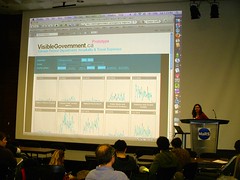 Image by jason_diceman via Flickr
VisibleGovernment.ca is a non-partisan non-profit dedicated to promoting the planning, funding, and implementation of online tools for government transparency in Canada.
See our Vision page for our view of how citizens and government could use the web to:
![Reblog this post [with Zemanta]](http://img.zemanta.com/reblog_e.png?x-id=9d9d99d4-088d-4117-8cde-00ce367e0ae1)
Harder than ever to get information from the federal government Last Updated: 26th January 2009, 4:26am As to highlight tomorrow's budget in Canada, President Barack Obama has coincidentally drawn attention to Canada's penchant for secrecy. By making "openness" and "transparency" a cornerstone of his presidency, he's drawn attention to Canada's lack of same. Not since the advent of the Access to Information Act (ATIA) in 1983, has it been so difficult to get timely information from the Canadian government. A challenge for Harper is to follow Obama's lead for more open government. Image via Wikipedia
Canada's cult of secrecy
![Reblog this post [with Zemanta]](http://img.zemanta.com/reblog_e.png?x-id=6b281bbc-3a7c-45ec-96b2-7c8157b86b44)
Opening government on Day One Keywords: Barack Obama; FOIA; FOIA enforcement; FOIA reform; open meetings; Open Records President Barack Obama, on his first full day in office, sent a strong message of his intention to run a transparent government, directing agencies to release information to the public when possible and rolling out a new White House Web site geared toward communication and transparency. Obama issued two presidential memos -- one on Transparency and Open Government and another specifically on the Freedom of Information Act -- instructing federal government agencies to operate under principles of openness and transparency. In this announcement at his first White House press conference, Obama committed to changing the course of the previous White House policy that asked federal government agencies to find ways under the law to keep information from getting out to the public. He instructed the attorney general to provide official guidance to agencies on implementing this policy change within 120 days. The new WhiteHouse.gov also discusses Obama's commitment to making his administration "the most open and transparent in history," and various means of communicating information to the public. That this message was issued on Day One is a huge step toward opening access to the federal government. And it is crucial that this message came from the very top. However, the public will need to be no less diligent in utilizing the laws to request information and continuing to hold this new administration accountable just as any other. — Corinna Zarek, 3:36 pm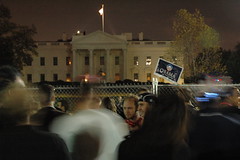 Image by Kevglobal via Flickr
![Reblog this post [with Zemanta]](http://img.zemanta.com/reblog_e.png?x-id=71ad50c4-87c8-4536-8112-811d25048571)
Feds get poor grade for accountability: Democracy Watch 3 days ago OTTAWA — An accountability watchdog says the Conservative federal government gets a D grade this year for transparency and democratic reform. Democracy Watch says the Harper government has strengthened or tried to strengthen accountability in a number of areas, but has weakened it in others, resulting in the poor grade overall. The report says the government could have earned a B grade had it implemented all the reforms promised in the 2006 election campaign. But it hasn't acted on 27 changes it promised, the group says. It also says the government has left a lot of loopholes that hurt accountability and transparency and should bring in a tougher accountability act. FULL ARTICLE: <http://www.google.com/hostednews/canadianpress/article/ALeqM5hpunA6-9cj-vxkUOz-pmWfcliTKA>
![Reblog this post [with Zemanta]](http://img.zemanta.com/reblog_e.png?x-id=ef56ba14-b821-4b1a-b6e7-c6de48a3e411)


 Posts
Posts


