Friday, February 27, 2009

Watchdog attacks federal cult of secrecy

Watchdog attacks federal cult of secrecy
Access to information so limited it’s a "crisis"

OTTAWA — There are serious flaws in the administration of the federal access-to-information law, says Information Commissioner Robert Marleau.

In a scathing report, Marleau gives six of 10 federal agencies poor grades on their compliance with a law that is supposed to give the Canadian public access to government files. He calls the situation a "major information management crisis."

"There are major delays, particularly with extensions, with some institutions routinely taking months to respond to information requests," Marleau said.

"Canadians expect and deserve far greater efficiency and accountability from their government."


FULL ARTICLE

Enhanced by Zemanta

Thursday, February 26, 2009

Government secrecy ‘grim,' watchdog says


Government secrecy ‘grim,' watchdog says

Globe and Mail Update

OTTAWA — The federal Information Commissioner is warning that Canadians' ability to get information from their government has reached a dire state.

The Harper Conservatives now routinely delay requests for government documents – a right of Canadians under the law – well beyond the 30 days that the Access to Information Act requires.

Six out of the 10 governments departments reviewed by the commissioner's office received failing grades.

“I do believe that its results provide a grim picture of the federal government's access to information regime,” Information Commissioner Robert Marleau says in a special report to Parliament.


FULL ARTICLE

Enhanced by Zemanta

Dr. Shiv Chopra - Canada's foremost Whistleblower at a Right to Know Coalition of NS events (Halifax Mar. 26th and Bible Hill Mar. 27th)

The Right To Know Coalition of Nova Scotia presents
Dr. Shiv Chopra,
Health Canada Scientist and Food Safety Whistleblower.

Halifax: Thursday, March 26th, 7:30 pm,
King's College, Alumni Hall, 6350 Coburg Rd.
Bible Hill: Friday, March 27th, 4:00 pm,
NS Agricultural College, Alumni Theatre, Cumming Hall
Are private interests impacting food and health safety? How is the Canadian government dealing with adverse or critical findings by Health Canada Scientists? How do we ensure a safe food supply for the public?

"Shiv Chopra is a Canadian hero. He was guided by science to conclusions that were not politically convenient" says Dr. David Suzuki.

Dr. Chopra and his colleague's work prevented approval of harmful drugs such as Bovine Growth Hormone, raised early attention to avoidable sources of Mad Cow Disease, questioned the Anthrax scare and warned about the myth of safe and effective vaccines.

His 2009 Corrupt to the Core, an account of how corruption is endangering the public food supply proposes "Five Pillars of Food Safety": to not employ:

Hormones, Antibiotics, Pesticides, Slaughterhouse/Rendered Animal Wastes,
OR Genetically Modified Organisms

All are welcomed to this free public presentation followed by Q&A.


The Right to Know Coalition of Nova Scotia is a not-for-profit organization which encourages the use and development of freedom-of-information legislation to foster a better informed and more politically active electorate and to improve the quality of public and private decision making. No other Nova Scotian organization has a similar mission.

The Right to Know Coalition acknowledges the support of Public Service Alliance of Canada, Nova Scotia Government Employees Union, Nova Scotia Agricultural College and Black River Hydro Limited.


For further information or to arrange interviews please contact Peggy Cameron (902) 492-4372 / 456-2004 or email <p.cameron@ns.sympatico.ca> see also: http://shivchopra.com/
Enhanced by Zemanta

New anti-secrecy plan surfaces on eve of damning report

Wednesday, February 25th, 2009

New anti-secrecy plan surfaces on eve of damning report

OTTAWA - MPs were given a new blueprint to renovate the country's antiquated access-to-information law on the eve of a scathing report from the federal information watchdog describing a system in sorry disrepair.

A New Democrat MP introduced a private member's bill Wednesday that would adopt measures Prime Minister Stephen Harper promised more than three years ago to adopt, but has yet to act on.

The bill is based on a comprehensive package drafted in 2005 by then-information commissioner John Reid


Former Information Commissioner John Reid - image by CBC
- reforms that would make more files accessible to the public, expand the commissioner's oversight powers and introduce measures to help ensure federal agencies comply with the act.

NDP MP Pat Martin said Wednesday there is more of a need than ever to scrutinize government activities given the billions of dollars in federal stimulus spending on the books.

"This whole thing is based on the premise that people have a right to know what their government is doing."

The Conservatives took office in early 2006 partly on the strength of promises of new accountability, including reforms to Canada's outdated Access to Information regime advocated by Reid.


However, the Harper government implemented only a handful, including the law's expansion to some additional agencies such as Canada Post, the CBC and Via Rail. The issue of access reform was shunted to a Commons committee for additional study.

"Nobody's going to fall for any of these stunts anymore," Martin said. "Those of us that have been around the block a few times on this issue will not accept anything other than a comprehensive reform bill."


FULL ARTICLE


Enhanced by Zemanta

Illinois Gov. Quinn orders better response to FOIA requests

WASHINGTON - FEBRUARY 03:  Illinois Gov. Pat Q... Illinois Governor Pat Quinn speaks to the media - Image by Getty Images via Daylife

Illinois Gov. Quinn orders better response to FOIA requests


advertisement
GateHouse News Service
Posted Feb 25, 2009 @ 06:41 PM

SPRINGFIELD, Ill. —

Gov. Pat Quinn told state agency directors and state lawyers Wednesday to “take all steps necessary to make information as accessible as possible" and better comply with the Freedom of Information Act.

Quinn spokesman Bob Reed said the directive is intended to let state workers know they “should have a pro-disclosure attitude toward FOIA.”

The purpose of the act is to provide members of the public access to government records. Certain types of information, such as medical files and security information, are exempt from the act.

A common criticism is that state agencies often deny requests for information based on broad interpretations of these exemptions.

In his memo, Quinn ordered FOIA requests to be considered “in favor of disclosure” instead of secrecy.

"In particular, FOIA requests shall be complied with in full conformity with both the letter and spirit of FOIA, and no decision to withhold information sought in a FOIA request shall be made to avoid embarrassment or for any speculative or other improper purpose," he wrote.


FULL ARTICLE

Enhanced by Zemanta

Solomon Islands Freedom of Information Workshop Ends

Thursday, February 26, 2009 11:02 AM

Freedom of Information Workshop Ends

The Solomon Islands from the air.Solomon Islands from the air - Image via Wikipedia

The Solomon IslandsImage via Wikipedia

Participants at the recent freedom of information workshop held in Honiara.
(Source: Photo Supplied)

The three days workshop on Freedom of Information (FOI) has come to an end yesterday at the Mendana hotel.

Ombudsman, Joe Poraiwai, thanked all the resource people and participants for their contribution, stating that the workshop will result in a draft FOI for the Solomon Islands.

Mr. Poraiwai stated that it will be the first of its kind, and will, in many ways, advance good governance in the country.

Meanwhile, Dr. Henry Ivarature, of the Pacific Islands Forum Secretariat, stated that the FOI is an important starting point for the Solomon Islands, but the country would have to learn through others experience, to see how FOI "works on the ground."

"There needs to be a lot of work to tell people about the FOI...this is the only way to move forward," said Dr. Ivarature. Dr. Ivarature said that as partners to the project support will continue to be given to the Solomon Islands, in terms of technical advice.

Dr. Ivarature thanked the Ombudsman for the courageous steps taken, even though there may be a lack of understanding on FOI issues by the general populace and even within government.

Enhanced by Zemanta

Wednesday, February 25, 2009

Jack Straw’s right, Cabinet Government matters

I think this is a great post to at least acknowledge the other side of the argument; that cabinet deliberations should remain out of the immediate reach of FOI.

- Greg

Jack Straw's right, Cabinet Government matters


by MatGB
February 25, 2009 at 7:43 pm

British Foreign Secretary Jack Straw meets wit...Image via Wikipedia


Jack Straw has decided not to appeal a decision and instead the Cabinet has voted, using the power allowed it by law the law, to prevent the release of documents, for the first time since the FOI Act was passed. Y'know what? I disagree with Justin, Jennieand most Lib Dems on this. He's right to do so. We can, and should, be attacking this, but not because Cabinet minutes aren't going to be released. Cabinet minutes should not be released, it's one of the basic principles of our Parliamentary democracy. Here's how it's supposed to work:

  • The House of Commons is elected as a representative cross section of British interests and opinions
  • A Cabinet is formed representing the views of enough members of the House to command a majority
    • Appointments are made based on support within the house and talent
  • The Cabinet discusses all major aspects of policy and agrees major decisions
    • The Cabinet is bound by Collective Responsibility and do not disagree in public
    • Ministers that cannot agree to a decision at all should resign
    • If the Cabinet no longer commands the support of the House, then the government should fall

In order for this system of government to work correctly, ministers have to be able to have free, open and frank discussions within Cabinet. If after discussion is over they come to a decision that a minister personally dislikes, the minister chooses whether this is a resigning issue or not. Robin Cook chose to resign before the Iraq War started. Clare Short was given assurances by the PM and had those assurances broken, so resigned after the war. That's the way it's supposed to work. That the Government didn't fall is not the fault of the Cabinet/Parliamentary system of government.

The problem lies not with the way this individual decision was made. The problem lies with the corrupted system that our Parliamentary democracy has become. This is the way it actually works:

  • The House of Commons is elected using a gerrymandered system created in 1947 that encourages:
    • an unrepresentative House with a two-party duopoly
    • A predominance of white middle class men in suits
    • Safe seats allocated by party fiat in which the rebellious are penalised
    • Party loyalty over individual thinking
  • A Cabinet is formed by the party leader, made up mostly of his/her friends or political allies
    • Appointments are made based on presentational ability and sucking up
  • The Prime Minister makes most major decisions and reveals them to Cabinet
    • Groupthink is both likely and encouraged
    • Discussion and debate is discouraged
    • Ministers who disagree with the PM are aware that challenging is a threat to their career
    • Super majorities from one party mean the Majority is rarely threatened

If a precedent is set for Cabinet minutes to be revealed during a period in office, then full and frank discussion within Cabinet is threatened. That it currently doesn't happen enough is part of the problem. If we are to retain the good aspects of the British system of Goverment, we need to get rid of the corruption and the parts that aren't working. Not attack the chances of the bits that sometimes do from happening.

British politics has allowed, over the last 60 years, to become increasingly corrupt and partisan. This is a fault of the electoral system, and specifically the introduction of uniform single member constituencies and the abolition of alternative voting methods made by the Representation of the Peoples Act 1948.

We need to remake and revitalise the Parliamentary system of government. For that to happen, we also need to examine how and why the Cabinet system works.

If it's decided that the Cabinet should have disagreements in public, that Collective Responsibility can be abolished, etc, then so be it. I can see arguments favouring that, especially in the new information age.

But to call for the abolishing of a fundamental feature of the British system, that has been working effectively for over 300 years, over a single, specific issue in which an abominable decision was made, is to throw out the baby with the rather murky bathwater.

Parliament voted for the Iraq war. The nation almost certainly opposed it. That is thereal problem. In defending the principles of our democracy, for once in his life, Jack Straw is right.

And if you think I liked typing that last sentence you really don't know me.

· About the author: Mat Bowles is a regular contributor to Liberal Conspiracy. He's a house-husband and freelance marketing consultant based in Yorkshire. A member of the Liberal Democrats, he is 34 and lives with fellow conspirator Jennie Rigg. His general interest blog is currently hosted on Livejournal and his old political blog is archived at Voting TaKtiX.

Reblog this post [with Zemanta]

Britain Refuses To Publish Cabinet Record Of Iraq War Decision

Straw appears at a press conference with Unite...Straw appears at a press conference with United States Secretary of State, Condoleezza Rice. - Image via Wikipedia

Britain Refuses To Publish Cabinet Record Of Iraq War Decision

February 25, 2009
(RFE/RL) -- The British government says it has vetoed publication of minutes from ministerial discussions about the legality of the 2003 invasion of Iraq.

Justice Secretary Jack Straw used the justification of "exceptional circumstances" to prevent publication of the cabinet records under the Freedom of Information Act.

In doing so, Straw overthrew a ruling by the British Information Tribunal, which had ordered the government to make available the records in the public interest.

Some lawmakers greeted his announcement with cries of "shame!"

Straw told the House of Commons that his decision to use the veto was motivated by his desire to avoid weakening the cabinet style of government, which he described as an integral part of British democracy.

"In short, the damage that disclosure of the minutes in this instance would do would far outweigh any corresponding public interest in their disclosure," Straw said.

He said that a key feature of the cabinet style of government is that it provides a space for thought and debate in private, and that advantage of candor would be lost if ministers knew their deliberations could be made public at any time.

Normally in Britain, cabinet papers are kept closed for 30 years.

FULL ARTICLE

Enhanced by Zemanta

Minnesota FOI award recognizes citizen lobbyist

FOI award recognizes citizen lobbyist

February 25, 2009

MINNEAPOLIS - A nonprofit group that fights for the public's right to government information is honoring a St. Paul man for doing exactly that.

Rich Neumeister was named Wednesday as the winner of the John R. Finnegan Award, given each year by the Minnesota Coalition on Government Information.

The group said Neumeister has worked for 25 years as a citizen lobbyist. He's appeared before numerous legislative committees and worked with legislators on issues such as freedom of information, privacy rights and government accountability.


FULL ARTICLE


Enhanced by Zemanta

Spending web sites make politicos take transparency seriously

WASHINGTON - SEPTEMBER 28:  (L-R) Speaker of t...WASHINGTON - SEPTEMBER 28: (L-R) Speaker of the House Nancy Pelosi (D-CA), House Financial Services Committee Chairman Barney Frank (D-MA), Senate Majority Leader Harry Reid (D-NV), and Senate Banking, Housing and Urban Affairs Committee Chairman Christopher Dodd (D-CT) hold a news conference at the U.S. Captiol September 28, 2008 in Washington, DC. The Congressional Democrats talked about the compromise legislation between Congress and the Bush Administration for the $700 billion bailout plan for the Wall Street financial crisis.Image by Getty Images via Daylife

Spending web sites make politicos take transparency seriously


By Lise Bang-Jensen
Manhattan Moment Columnist | 2/24/09 6:10 PM

Did $165 billion in taxpayer dollars disappear into the ether? Probably not, but eight top financial executives, appearing before a House committee last week, were unable to account for how they spent federal bailout money.

The episode speaks poorly for the banking industry. (Let’s hope banks are more prudent with our personal checking accounts.) It also makes government look terrible—and increases demands that the federal government track every dollar of the $789 billion stimulus plan.

Transparency has emerged as a political buzzword, but it’s not a new concept. Thomas Jefferson observed, “Information is the currency of democracy”. Two centuries later, another president, Barack Obama, has promised “an unprecedented level of openness in government”.

Democrats and Republicans, liberals and conservatives embrace the transparency movement. As a U.S. senator, Obama joined with Republicans Tom Coburn of Oklahoma and John McCain of Arizona in co-sponsoring the Federal Funding and Accountability Act of 2006. It posts federal contracts and grants on a website, www.usaspending.gov

Government transparency is about more than tracking federal contracts or stimulus funds. Citizens have a right to know how every tax dollar is spent.

FULL ARTICLE

Enhanced by Zemanta

Monday, February 23, 2009

the Wobbing Europe 'wobsite'

Wobbing Europe: Freedom of Information for good stories

Wobbing.eu aims to inspire and support journalists to use their right of freedom of information as a journalistic tool.
Wobbing.eu aims to build a network, where journalists who use freedom of information legislation can meet and exchange experiences.
Wobbing.eu aims to watch developments of freedom of information legislation in order to further stronger legislation useful for journalists.

Wobbing is a verb, it is Dutch journalist’s slang expression for Freedom of Information or Access to Documents legislation. It derives from the name of the Dutch and Flemish laws: Wet van Openbaarheid van Bestuur, which means Law about the Openness of the Administration.

Wobbing.eu is a trademark-protected name in the Benelux.

The Belgian Pascal Decroos Fund runs Wobbing Europe. The Pascal Decroos Fund is an independent Belgian-Flemish foundation working for special journalism and funded by the Flemish Government. It provides grants to journalists for investigative and special research projects, in print and audio-visual media in Dutch language in Belgium.
Pascal Decroos was a special journalist with special ideas. He was born in Ostend (Belgium) on 20 April 1964 and died in Brussels (Belgium) on 2 December 1997. Pascal Decroos is the exponent of a new generation of journalists. Someone with a passion for journalism and committed to the case of the weaker in our society. In the course of his professional career, Pascal Decroos earns himself the reputation of being a critical, inventive television journalist. His creed is: do not let yourself be carried along the stream of superficial news, but submerge. Do not content yourself with drawing the obvious conclusion, but investigate and probe until you find the truth.


Wobbing Europe,
Editor Brigitte Alfter

The Pascal Decroos Fund for Investigative Journalism, Director Ides Debruyne


Rozenweg 4b
B-1731 Zellik
Belgium
Tel +32 2 705 59 19
fax +32 2 705 59 29
e-mail: ides.debruyne@fondspascaldecroos.org
www.wobbing.eu
Account number 422-8004971-11
IBAN: BE30 4228 0049 7111
KBC Bank NV BIC of SWIFT address: KREDBEBB
NATIONAAL NUMMER 463312580

http://www.wobbing.eu/

Enhanced by Zemanta

Cayman Islands First Freedom of Information Unit Report on Implementation January 2009

Coat of arms of the Cayman IslandsCoat of arms of the Cayman Islands - Image via Wikipedia

Cayman Islands First Freedom of Information Unit Report on Implementation January 2009 (PDF)

The Freedom of Information Law was brought into effect on January 5th 2009. The FOI Unit will issue a monthly statistical report on implementation which will summarise the number of FOI requests received by public authorities and the decisions that were made during that month. Public authorities have up to a maximum of thirty calendar days to respond to an FOI request with a decision to grant, refuse or defer access and therefore this reporting period will not reflect decisions on all requests submitted during the month of January.

Between January 5, 2009 and January 31, 2009, eighty-eight public authorities received a combined total of one hundred and seventeen requests for information under the FOI Law.

Of the thirty-six requests that were closed in this time period, twelve were granted in full, two
were granted in part, and five were exempt in their entirety. Four applicants requested
records that were available in the public domain and eight other applicants asked for certain
information but the Information Managers determined that their public authority held no
records related to that request. Three requests were withdrawn by the applicants, one
request was refused under Section 9(c) of the FOI Law and one request was deferred under
Section 11(2).

FULL DOCUMENT
Enhanced by Zemanta

Lag in releasing listeriosis notes breaks information law: experts

Listeria monocytogenesListeria monocytogenes - Image by AJC1 via Flickr

Lag in releasing listeriosis notes breaks information law: experts

OTTAWA — The Harper government has delayed for months the release of notes on conference calls held at the height of last summer's deadly listeriosis outbreak - a lag some experts say breaks Ottawa's own information laws.

At issue is an Access to Information request by The Canadian Press to the Privy Council Office for "all transcripts and minutes" of the crucial exchanges last August and September.

PCO-PMOPrivy Council Office (PCO) - Image by jascha via Flickr

Officials were grappling at the time with a health crisis that sparked intense scrutiny of the national food safety system.

Twenty Canadians died after developing listeriosis, an outbreak that was traced to meat-processing equipment at a Maple Leaf Foods plant in Toronto.

Privy Council officials at first said they had records as requested, but needed four months "to consult other government institutions" about them.

Then Ann Wesch, the access to information director for PCO, wrote a letter dated Feb. 10 stating that in fact "the records retrieved do not fall under the scope of this request. Therefore we have no records relevant to your request."

The explanation for the flip-flop? Records retrieved were handwritten notes - not minutes or transcripts, said the PCO analyst questioned about the response.

This, despite the fact that the word transcribe is in part defined in the Canadian Oxford Dictionary as "make a copy of, esp. in writing . . . write out (shorthand, notes, etc.) . . . ."

Agriculture Canada, in an apparent contradiction of PCO's interpretation, released handwritten notes in answer to an identical request for related transcripts.

Retired Col. Michel Drapeau, a lawyer who co-wrote a book on federal information laws and teaches at the University of Ottawa, was astounded by the Privy Council response.

"It is silly," he said. "I would even say it's infantile to be making this sort of distinction.

"This goes against the spirit of the act and the letter of the act."

Drapeau stressed that the Harper government's own Federal Accountability Act added the onus of a "duty to assist" for institutions that fall under the Access to Information Act.

It requires that federal officials, "without regard to the identity of the person making a request . . . make every reasonable effort to assist the person in connection with the request, respond to the request accurately and completely and, subject to the regulations, provide timely access to the record in the format requested."

What's most disturbing, says Drapeau, is the tone that the Privy Council Office is setting as the public-service standard bearer providing advice and support to the prime minister and cabinet.

"The Privy Council has a duty by virtue of its mission in life to serve as a beacon, to serve as an example, to all public servants - because this is where all authority flows from. This is why the head of the Privy Council Office is also . . . the top public servant.

"And they're setting a bad example. Simple as that."

FULL ARTICLE

Enhanced by Zemanta

Friday, February 20, 2009

South West Shore Development Authority (SWSDA) tosses reporter from closed meeting

SWSDA tosses reporter from meeting...
Shelburne County Today
18feb2009


Despite the recent ruling by the Nova Scotia Supreme Court that the South West Shore Development Authority (SWSDA) was a public agency according to the laws of the Province and despite protests by several member politicians, CEO Frank Anderson had the Shelburne RCMP escort SCT editor and publisher Timothy Gillespie from the Shelburne meeting of the agency in Shelburne early Wednesday morning.

Anderson told Gillespie that, despite the court ruling, he considered the meeting a "private" one and not open to the public or the media. In a November, 2008 decision, Supreme Court Justice Suzanne Hood determined that, because its membership is comprised almost exclusively of elected officials and the agency's funding is almost exclusively from public funds, SWSDA is a "municipal body" and should not be exempt from legislation controlling their actions.

...

One SWSDA member reported that the board of directors decided at the meeting that the agency was obliged to conform to Freedom of Information requests as "municipal agency", but determined that they were not subject to public meeting legislation. "In light of the court's recent ruling," said an authority on the governing legislation," that is a patently absurd and dangerous conclusion. All of the municipalities which comprise SWSDA are now subject to almost certain legal action in the courts and to all of the costs and bad publicity that will entail."

...
FULL ARTICLE

Enhanced by Zemanta

Wednesday, February 18, 2009

A fellow Canadian advocacy group worthy of note: Lawyers Rights Watch Canada (LRWC)

Lawyers Rights Watch Canada (LRWC) is a committee of Canadian lawyers who promote human rights and the rule of law by providing support internationally to human rights defenders in danger. LRWC promotes the implementation and enfosigned to protect the independence and security of human rights defenders around the world.

LRWC:

  • campaigns for lawyers whose rights, freedoms or independence are threatened as a result of their human rights advocacy; and,

  • produces legal analyses of national and international laws and standards relevant to human rights abuses against lawyers and other human rights defenders; and,

  • works in cooperation with other human rights organizations.


Around the world, lawyers and others who defend human rights are often singled out as targets of repression much of which is perpetrated by governments or government-controlled agencies. Criminal offences against human rights defenders occur with alarming frequency. The 2002 report of the International Commission of Jurists records reprisals against 315 lawyers and judges including 38 murders and 5 disappearances.

In addition authorities use existing laws and legal procedures to prosecute or otherwise intimidate advocates representing unpopular clients or causes, often in violation of international standards. Methods used to silence intimidate or punish advocates are often illegal pursuant to the law of the state itself.

LRWC seeks to identify illegal actions against advocates, campaign for the cessation of such actions and lobby for the implementation of effective immediate and long-term remedies.


Recent Publication in the Jurist:

Omar Khadr: Release, Repatriation, and Remedies

JURIST Special Guest Columnist Gail Davidson, Executive Director of Lawyers Rights Watch Canada, says that Canada and the US are duty-bound to act immediately to ensure that Canadian Guantanamo Bay detainee Omar Khadr is released and repatriated, his rights are protected and violations of his rights are investigated and remedied, where appropriate, by

Photo of Omar Khadr, copyright released into t...Omar Khadr - Image via Wikipedia

criminal proceedings against the perpetrators....
Enhanced by Zemanta

Nauru considers freedom of information rules

This is The Republic of Nauru. All of it.Image by Tatters :) via Flickr

Nauru considers freedom of information rules
Posted at 02:18 on 18 February, 2009 UTC

The President of Nauru says making information accessible to the public will ensure government is transparent and that the public is better able to hold government accountable.

Marcus Stephen was delivering the keynote address at the opening of a freedom of information workshop, which opened yesterday in Nauru.

Map of the island nation of the Republic of Na...Image via Wikipedia


The four day workshop has been organised by the Nauru Government, with support from the United Nations Development Programme, the Pacific Islands Forum and the Commonwealth Human Rights Initiative.

It aims to raise awareness about the value of the right to information, and to provide technical advice on what should underpin any such legislation.
Nauru is trying to eradicate the corruption that has long plagued the country.
Mr Stephen says if Nauru introduces freedom of information legislation, the island will have an additional tool in its quest to wipe out corruption.

News Content © Radio New Zealand International
PO Box 123, Wellington, New Zealand

Tuesday, February 17, 2009

Canadian Access-to-information laws too weak: Watchdog


Access-to-information laws too weak: Watchdog


BY DAVID AKIN,
CANWEST NEWS SERVICE
FEBRUARY 17, 2009 3:01 PM


Canada's information commissioner of Canada, Robert Marleau
Photograph by: Kier Gilmour, Canwest News Service

OTTAWA — Canada's information commissioner says existing access-to-information laws are too weak. and lack measures that would force the federal government to hand over the records Canadians have a right to see.

Commissioner Robert Marleau will table "a shopping list of legislative amendments" next month for MPs to consider. But he says it's vital Treasury Board President Vic Toews take steps to force individual government departments to give their access-to-information offices the money and staff to fulfil their legal obligations under Canada's Access to Information Act.

FULL ARTICLE


Reblog this post [with Zemanta]

Transparency and the Web - public domain advocate Carl Malamud

w:en:Carl Malamud holding a talk at Berkeley a...Image via Wikipedia

Tuesday, February 17, 2009; A11

Transparency and the Web

Already, the struggle to digitally upgrade federal agencies seems certain to be one of the central challenges of the new administration as it seeks to create a more transparent government.

Just ask public domain advocate Carl Malamud. "I've been putting government online for ages," says the 49-year-old from Sebastopol, Calif.

Malamud first put difficult-to-access Security and Exchange Commissions records online in early 1994, ultimately leading the SEC to open up its EDGAR database by making the information available online.

Now Malamud is pushing to make "America's operating system," as he calls federal court records, no more than a Google search away.

Launched in early 2007, his nonprofit group, PublicResource.org, has found that effort somewhat controversial, with pushback from privacy advocates and the PACER (Public Access to Court Electronic Records) system that has until now had a monopoly on online access to the files, which are stored in a pay-per-page database.

FULL ARTICLE

Monday, February 16, 2009

VisibleGovernment.ca is dedicated to promoting online tools for government transparency in Canada

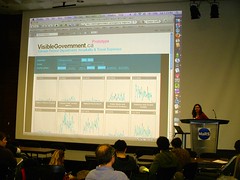
VisibleGovernment.ca PresentationImage by jason_diceman via Flickr

VisibleGovernment.ca is a non-partisan non-profit dedicated to promoting the planning, funding, and implementation of online tools for government transparency in Canada.

See our Vision page for our view of how citizens and government could use the web to:

  • engage citizens in the democratic process
  • improve bureaucratic efficiency
  • achieve 'radical' transparency
Visit our Projects section to see what's currently on the go. Have an idea for a project? Send it to projects@visiblegovernment.ca. If you'd like to be involved in the planning for VisibleGovernment.ca, join the general discussion on our newsgroup, or sign up for our mailing list for announcements.
Also, check out our Links section to see who we're inspired by -- online tools from citizen groups in other parts of the world, as well as here in Canada.

Also see: I Believe in Open
Reblog this post [with Zemanta]

CBC's Nora Young interviews Rahaf Harfoush on government transparency

Nora YoungNora Young - Image by SparkCBC via Flickr

Full interview: Rahaf Harfoush on government transparency

As transparency and two-way communication become the norm in business, media, and journalism, why has so much of what’s happened in Ottawa recently taken place behind closed doors? Is there something Canada can learn from the transparency of the Obama campaign and transition in the US?

This week, Nora interviewed Rahaf Harfoush. Rahaf is a new media strategist, and she worked as a full-time volunteer on the Obama campaign’s new media program. A shorter version of this interview airs on Spark 57, but you can hear the full, uncut interview below, or download the MP3.

Rahaf Harfoush - Posted by Dan Misener under Uncategorized
Reblog this post [with Zemanta]

CBC's Nora Young interview with Tom Steinberg on Transparency in Government

Nora Young, Canadian radio broadcaster.Nora Young - Image via Wikipedia

Full Interview: Tom Steinberg on Transparency in Government

Posted by Nora Young under Uncategorized

This morning I spoke to Tom Steinberg, director of MySociety, a not-for-profit that creates websites designed to connect citizens in the UK with government, in practical, transparent ways.

Tom Steinberg at OpenTech 2005 Tom Steinberg - Image by matlock via Flickr

The MySociety approach gets citizens interested through personal, practical projects (getting potholes fixed on a neighbouring street, say, or getting a record of comments their MPs have made on a particular issue) and from there, hopes to stimulate interest in democratic participation.

What intrigued me about MySociety is that they’re mostly relying on publicly available information, but they’re making it accessible to people in practical, user-friendly, and accountable ways.

What do you think of the MySociety approach? Does it have applications for Canada? Let me know what you think!

We’re airing a shortened version of this conversation on the next episode of Spark, but you can listen to the entire talk below, or you can download the MP3.


Reblog this post [with Zemanta]

Friday, February 13, 2009

FOI commissioner blasts B.C. government

FOI commissioner blasts B.C. governmentParliament Bldgs Victoria BC

VANCOUVER — B.C.'s Information and Privacy Commissioner is criticizing the provincial government for what he calls its failure to tackle the chronic problem of delay in responding to freedom of information requests.

In his first annual report on FOI performance, "Timeliness of Government's Access to Information Responses", released Friday, David Loukidelis describes what he calls "an unacceptable pattern of government-wide failure to respond to access requests in as timely a fashion as it should."

FULL ARTICLE

Reblog this post [with Zemanta]

Thursday, February 12, 2009

What US Gov Docs Would You Like to See Published?

Seal of the United States Congressional Resear...Image via Wikipedia

What Gov Docs Would You Like to See Published?

by Jennifer LaFleur,
ProPublica
February 12, 2009 8:58 am EST

ShowUstheData.org

ShowUstheData.org

[1]The 1996, yes, 1996 revision of the Freedom of Information Act, known as EFOIA [2], called for federal agencies to post frequently requested documents on their Web sites.

Guess what? Not every agency did it.

But now that transparency is hip, open government advocates have created a Web site [1] so folks can tell the government what documents they would like to see made public.

The site, Show us the Data [1], is a joint project of the OpenTheGovernment.org and the Center for Democracy and Technology. They only have a few votes, but the currently most wanted document is something we wrote about Tuesday [3] -- reports of the Congressional Research Service. CRS reports would not fall under the 1996 EFOIA amendments, but open-records advocates have argued for years that the information should be public.

There aren't a lot of votes on the site yet -- but the site just opened yesterday.


FULL ARTICLE

Reblog this post [with Zemanta]

Irish Opposition Call for cut in FOI fees rejected

Department of the Taoiseach in Merrion Square,...Image via Wikipedia

Call for cut in FOI fees rejected

MARIE O'HALLORAN

Thu, Feb 12, 2009

MEMBERS OF the Oireachtas Public Accounts Committee got more information about expenses in the State agency Fás through freedom of information (FOI) requests than from documentation the agency supplied directly to the committee, the Dáil was told.

Fine Gael leader Enda Kenny said that was a justification for the FOI system as he called on Brian Cowen to ensure “State bodies provide the fullest possible information when freedom of information requests are made”.

He raised the issue as the Taoiseach rejected calls for fees for FOI requests to be reduced to a flat rate of €10 for requests, reviews and appeals.

Sinn Féin Dáil leader Caoimhghín Ó Caoláin also called for the implementation of a recommendation by the Information Commissioner to end charges for requests and appeals. “In light of the scandals in banking and Fás” he said it was the “absence of scrutiny that has given rise to much of what we have witnessed”.

Requests cost €15, which Mr Cowen said was “modest” when the administration cost of processing a request was estimated at an average of €485.

Earlier, Mr Cowen said he would consider a call by Labour leader Eamon Gilmore that there should be a “wall” between a Minister responsible for a scheme of expenses and any agency implementing the scheme. However, the Taoiseach said “why not have greater transparency from the State agency in the first place”.

FULL ARTICLE

Reblog this post [with Zemanta]

Wednesday, February 11, 2009

Assembly passes FoI changes

The ACT Legislative Assembly buildingImage via Wikipedia

Assembly passes FoI changes

12/02/2009 1:00:00 AM
The Australian Capital Territory (ACT) Legislative Assembly passed new Freedom of Information laws yesterday that will make it easier to obtain Government documents.

The ACT Greens backed the Opposition's proposed amendments to the territory's Freedom of Information Act, which will remove the Government's right to restrict access to documents through the use of conclusive certificates.

ACT electorates, as depicted at http://www.kat...ACT Electorates - Image via Wikipedia

FULL ARTICLE

Reblog this post [with Zemanta]

FoI has made the BBC rethink its spending

BBC, UKImage by allaboutgeorge via Flickr

Media law: 'FoI has made the BBC rethink its spending'

11 February 2009

The BBC could be 'the Freedom of Information Act's first major scalp' as its spending is made public, Press Gazette's media law conference heard this morning.

Matt Davis, director of news agency DataNews, said the corporation will cut budgets as more largesse is revealed.

He cited the BBC's accommodation bill during the 2006 World Cup in Germany - £1.6m – which was released under FoI laws.

"Do you think that sort of accommodation will be rubber-stamped next time?" he asked.

Davis also cited the BBC's Christmas party bill.

"Every year the figure has been headline news," he said. "In 2007, the bill was £250,000, with a £50 per head limit.

"This year, it was £60,000, with a £25 per head limit. Do you think that level of cutback would have come about without Freedom of Information?"

Davis said the BBC had embraced the FoI law, creating a team to answer questions, and setting up an FoI blog.

But he said the BBC had, initially, stopped much of its own information becoming public by citing "journalistic, artistic or literature" reasons.

Even the cost of running the Blue Peter Garden, Davis said, had been kept secret under this exemption.

But, gradually, what it keeps secret has been chipped away by a number of rulings – springing "leaks in the dyke".

The corporation could be "clinging to its information jewels with water gushing round its wellies," Davis said.

"If the BBC thought the level or scrutiny it gets now is bad, just wait," he added.


FULL ARTICLE

Enhanced by Zemanta

Monday, February 09, 2009

Journalist to continue fight for free press in China

Journalist to continue fight for free press in China
February 09, 2009
DEBRA BLACK
STAFF REPORTER

For investigative journalist Jiang Weiping, who was charged with subversion in the People's Republic of China and served a six-year term in prison, the idea of press freedom is much more than a lofty principle. It is something he hopes will one day become a fact of life in his homeland.
"Under the current political system in China, the job of a journalist is a high-risk one," Jiang said in his native Mandarin through a translator at a PEN news conference at Massey College in downtown Toronto Monday.

"It takes enormous courage to speak out against those in power, but this is no excuse for media workers to ignore their duty," he said. "A free press is an effective means of preventing officials from abusing their power, and is also vital in advancing social development. A healthy civil society not only enshrines freedom of expression but also welcomes dissenting opinions."

FULL ARTICLE

Reblog this post [with Zemanta]

Annual Australian FOI report is released to public

Sydney AustraliaImage by Michael McDonough via Flickr

Annual FOI report is released to public

The latest annual report on the operation of the Freedom of Information laws has been released by the Special Minister of State, Senator John Faulkner.
According to the report, Australian Government Agencies received 29,019 FOI access requests in 2007-08, spending $29.5 million processing them at an average cost of $940 per request.
Senator Faulkner

w:en:John Faulkner - sourceSenator John Faulkner - Image via Wikipedia

said just two per cent of the cost of the scheme was recovered in fees and charges.
“The majority of r
equests were directed to Centrelink (9,849), the Department of Immigration and Citizenship (7,912) and the Department of Veterans’ Affairs (6,491),” Senator Faulkner said.
He said 85 per cent of the requests received by Agencies were for personal information about the applicant or other people.
“The remaining 15 per cent were for documents containing other information, such as documents concerning policy development and government decision-making,” he said.
“Some 96 per cent of FOI requests finalised in the reporting period were granted in full or in part.”
Senator Faulkner said 38 per cent of the FOI requests for non personal information were granted in full, 53 per cent in part and nine per cent were denied.

FULL ARTICLE
Reblog this post [with Zemanta]

Saturday, February 07, 2009

11th annual US National FOI Day Conference March 13 2009

The Bill of Rights, the first ten amendments t...Image via Wikipedia


2009 FOI conference set for March 13 News release First Amendment Center Online staff 02.06.09
WASHINGTON — The 11th annual National FOI Day Conference will be held on Friday, March 13, in the Freedom Forum’s Newseum.
The theme of this year’s conference, hosted by the First Amendment Center, is “Freedom and Information: Looking Back and Looking Forward.”
The program will include legal scholars, lawyers and journalists discussing the state of freedom of information after the Bush administration and its prospects in the Obama administration.
David Vladeck, a Georgetown University law professor, will speak on “The Last Eight Years: Freedom of Information in the Bush Era.” Meredith Fuchs, general counsel for the National Security Archive, will moderate a discussion afterwards with the following commentators: Mike German, national-security expert, American Civil Liberties Union, Mark Tapscott, editorial-page editor, The Washington Examiner, Richard A. Samp, chief counsel for the Washington Legal Foundation, and Professor Rena Steinzor of the University of Maryland School of Law.
The FOI Day Conference, which brings together access advocates, government officials, lawyers, librarians, journalists, educators and others, is presented in association with Sunshine Week, the American Library Association and OpenTheGovernment.org.
The conference will begin at 8:30 a.m. and end at noon. It will be at the Knight Conference Center at the Newseum, 555 Pennsylvania Ave., N.W., 7th floor. (Use the Sixth Street entrance.)
Ronald K.L. Collins, First Amendment scholar, said, “We as a nation may be at a turning point when it comes to open government. Of course, that remains to be seen. Meanwhile, we need to assess where we’ve been and where we’re going so far as freedom of information is concerned. This year’s FOI conference addresses just such concerns.”
There is no charge to attend, but because space is limited, participants must register individually in advance. To register for the 2009 National FOI Day Conference, you must: Send an e-mail to ahampton@freedomforum.org or call 202/292-6288. When registering, please provide your name, title, affiliation and contact information.
The First Amendment Center works to preserve and protect First Amendment freedoms through information and education. The center serves as a forum for the study and exploration of free-expression issues, including freedom of speech, of the press and of religion, and the rights to assemble and to petition the government. It is nonpartisan and neither litigates nor lobbies.
The First Amendment Center, with offices at Vanderbilt University in Nashville, Tenn., and Washington, D.C., is an operating program of the Freedom Forum and is associated with the Newseum and the Diversity Institute. Its affiliation with Vanderbilt University is through the Vanderbilt Institute for Public Policy Studies. Its offices on the Vanderbilt campus are located in the John Seigenthaler Center.
Contact:Ron Collins, 202/292-6292Related National FOI Day
Reblog this post [with Zemanta]

Thursday, February 05, 2009

Quote of the Day

LogoBrandeisImage via Wikipedia

"When transparent and accountable governance is circumvented anywhere in the university, we all suffer.''

- from a letter signed by more than 60 faculty members of Brandeis University, including some of the most prominent and longest-tenured professors to President Jehuda Reinharz on his decision to sell off the university's $350 million art collection.

Reblog this post [with Zemanta]

Wednesday, February 04, 2009

NL premier's branch of the civil service using its clout to foil FOI requests

Last updated at 9:29 AM on 06/12/08

Executive decisions

The premier's branch of the civil service has been quietly involved in vetting responses under the province's freedom of information laws, directing other

Golfing with Premier Danny Williams.Premier Danny Williams - Image via Wikipedia

public bodies to keep information secret

ROB ANTLE
The Telegram

The branch of the civil service that serves the premier's office has been directing other government departments and agencies to keep information secret from the public, ignoring recommendations to the contrary from an independent officer of the House of Assembly.

Executive Council has no actual legislative authority to tell other public bodies what to do.

But documents pieced together by The Telegram over the past six months reveal that Executive Council is using its clout - mainly under instructions contained in a government policy manual - to keep information secret.


FULL ARTICLE
Reblog this post [with Zemanta]

NL Government withholding school reports

City of St John'sImage via Wikipedia

Government withholding school reports

EDUCATION

Engineering assessments of Holy Heart, Bishops still in 'draft' form, months after decisions made


ROB ANTLE
The Telegram

Holy Heart of Mary Regional High School is slated for closure as a part of school restructuring in St. John's. — Photo by Joe Gibbons/The Telegram

The provincial Department of Education is withholding engineering reports on the state of two St. John's high schools, claiming the reports are still in draft form - even though the local school authority made decisions four months ago based in part on the reports' findings.

On March 5, The Telegram asked for copies of the engineering reports for Bishops College and Holy Heart of Mary High School.

But Friday - 23 days after the initial request - department officials said the reports are still not final, and cannot be released to the public.

Provincial officials said that consultants are making minor revisions to the studies, correcting information such as the age of Holy Heart, which was listed incorrectly.

They said a misunderstanding led to the department not making it clear three weeks ago that the reports were still in draft form.

"Every effort is being made to get it finalized, and to be able to release it," Department of Education spokeswoman Jacquelyn Howard said.

She denied that the department is classifying the reports as drafts to delay making them public. But the government won't release what it has now.

"That would be a draft report, that's something we don't do - we're not going to release a draft report, it has to be finalized," Howard said.

"There is no intent to withhold it; it's clarifying information that's in it," Howard added.

FULL ARTICLE
Reblog this post [with Zemanta]

Corner Brook gets D+ in freedom of information audit print this article

Last updated at 10:46 AM on 10/01/09

Corner Brook gets D+ in freedom of information audit print this article
ST. JOHN'S
ROB ANTLE
The Telegram

A national freedom of information (FOI) audit found a tale of two cities in Newfoundland and Labrador.

St. John's ranked third-best out of 22 municipal governments across the country surveyed by the Canadian Newspaper Association, garnering a grade of B.

But Corner Brook was near the bottom of the pile, in 16th spot. The west coast city earned a grade of D+.

The Canadian Newspaper Association - in conjunction with the University of King's College in Halifax - carried out the FOI audit, which ran from August to November 2008.

FULL ARTICLE


Reblog this post [with Zemanta]

Tuesday, February 03, 2009

Montreal's La Presse uses FOI to get Casey RCMP report

Casey says Tories tried to smear him
Outraged MP asks speaker to investigate false accusations
By STEPHEN MAHER
Ottawa Bureau
Tue. Feb 3 - 6:27 PM


OTTAWA — During the last election, Conservatives went to the RCMP to complain that Bill Casey embezzled money from the party — an accusation that the party knew was wrong because they had the financial records that showed it, Mr. Casey said in the House of Commons on Tuesday.Mr. Casey learned of what appears to be an attempt to smear him with a false accusation when a reporter for Montreal's La Presse contacted him last week. The paper had acquired through an access-to-information law a report to the RCMP commissioner on the investigation.

The report says that on Sept. 19, during the election campaign, Conservative party members went to the Bible Hill RCMP detachment to “report the embezzlement of funds by Member of Parliament.”

At issue was $30,000 that the Cumberland-Colchester Conservative riding association transferred to an election campaign fund before Mr. Casey was expelled from the Conservative caucus for voting against his government in a dispute over the Atlantic accords.

But the money was returned to the federal party nine days after he was expelled, Mr. Casey says, and the party is aware of that.

The report to the commissioner says there was “not sufficient grounds or cause to merit the commencement of an investigation.”

FULL ARTICLE

Reblog this post [with Zemanta]

NDP get Nova Scotia Power billing statistics through FOI request

NDP: Too few get heat relief

Nova Scotia Power StacksTufts Cove - Image by Property#1 via Flickr


Thousands not getting sales tax break because of rebate

Nova Scotia PowerImage via Wikipedia

rules, Dexter says

Thousands of Nova Scotians who heat with electricity aren’t getting the sales tax break they should be getting, according to the NDP.

The province says it rebates the eight per cent provincial portion of the harmonized sales tax on electricity used for heat. It assumes people use an average of 27.4 kilowatt hours of power a day for lights and appliances, and amounts above that are for heat and have the rebate applied.

But the government’s number-crunching is flawed because there are people who don’t meet the rebate threshold, even though they heat with electricity, NDP Leader Darrell Dexter says.

Ontario general election, 2003Image via Wikipedia

"Those households, by and large, would be the one-bedroom, two-bedroom apartment kind of homes," Mr. Dexter said in an interview Friday.

"Generally, I think it’s fair to understand that those would be the poor people, those would be the lowest-income people who would be losing the HST rebate."

He pointed to Nova Scotia Power billing statistics, which show 21,611 customers who say they heat with electricity solely had used less than 10,000 kilowatt hours a year, or 27.4 kilowatt hours a day.

The statistics, from 2004, were included in the response to an NDP freedom of information request for the province’s analysis on the electricity rebate threshold. More recent statistics could not be obtained Monday.

The amount of money at stake would differ by customer. If someone used 2,000 kilowatt hours for heat, the rebate should be about $19; if it’s 5,000 kilowatt hours, it’s about $47.

FULL ARTICLE

Reblog this post [with Zemanta]

Monday, February 02, 2009

Transparency Watch Jan'09 issue now available online


JANUARY 2009 issue now available online

Reblog this post [with Zemanta]

New UK information chief pledges action on FoI backlog

New information chief pledges action on FoI backlog

30 January 2009

The new Information Commissioner, Christopher Graham, has pledged to make reducing the substantial backlog of Freedom of Information appeals a priority when he takes up the job this summer.

Graham, who has been selected by the Ministry of Justice to replace

Richard Thomas (Information Commissioner)Outgoing IC Richard Thomas - Image via Wikipedia

Richard Thomas

at the end of June, was grilled by MPs on the justice select committee in a pre-appointment hearing this week.

Although the Information Commissioner's Office now settles more cases than it receives each year, it is still feeling the effects of a huge backlog which built up in the first year of the Act, four years ago.

The body receives £5.5m a year in funding from the Ministry of Justice, and employs 53 case-workers to deal with FoI complaints.

Justice committee chairman Sir Alan Beith, the Libreal Democrat MP for Berwick Upon Tweed, asked Graham whether the MoJ had promised him any extra resources to clear the backlog.

"It is very challenging," Graham replied. "I have not had any discussions with the Ministry of Justice about resources. I have not had many discussions beyond the job application. I think the fun now starts."

He added: "The freedom of information side looks to be pretty tightly resourced. It is a backlog that has been there pretty much from day one.

"It will be interesting to see how we can deal with that increase and clear up the backlog unless there are significant resources made available, but I would also say that this is a problem that is not unfamiliar to me."

Graham, a former BBC journalist who has led the Advertising Standards Authority since 2000, said one of his first priorities when he joined the ad watchdog had been to ensure complaints were handled more quickly.

FULL ARTICLE


Reblog this post [with Zemanta]

Herald finds faulty mechanics through FOI

Garage mechanic near Newark, N.J. Badge denote...Image by The Library of Congress via Flickr

Careful with that wheel wrench!
Tighter inspection rules get some mechanics barred from doing MVIs


The province yanked the licence of 25 mechanics last year for conducting shoddy motor vehicle inspections.

The Registry of Motor Vehicles also took the licence to perform inspections from 14 service stations for various violations, according to documents The Chronicle Herald obtained through the Freedom of Information and Protection of Privacy Act.

RELATED
» Click here to see a breakdown on mechanics and service stations for the past three years


Further information can be viewed at thechronicleherald.ca.

FULL ARTICLE

( jsimpson@herald.ca)


Reblog this post [with Zemanta]